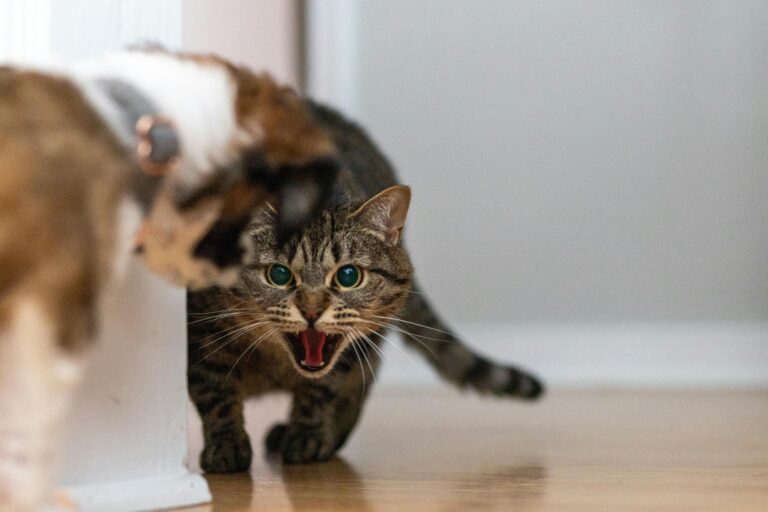

Sharing your home with both cats and dogs can be incredibly rewarding. When the relationship works, they may become playmates, nap near each other, or simply develop a quiet understanding of how to share the same space.
But peaceful coexistence doesn’t always happen naturally—and it doesn’t have to look like friendship to be successful.
Cats and dogs communicate differently. A dog may approach enthusiastically because they want to play, while a cat may interpret that same energy as threatening. A cat’s quick movement across the room may be completely innocent, but it can trigger a dog’s instinct to chase. Understanding these differences is the first step toward creating a home where both animals feel safe, respected, and comfortable.
Start With the Right Introduction
Whether you’re bringing a new cat into a home with a dog or introducing a new dog to your resident cat, resist the temptation to simply put them together and “let them figure it out.”
Successful introductions are usually slow and controlled.
Begin by giving the new pet their own safe area. Allow both animals to become familiar with each other’s scent before expecting them to interact face-to-face. Bedding, blankets, or toys can be exchanged between spaces so each animal can investigate the newcomer without the pressure of direct contact.
When visual introductions begin, use barriers such as baby gates or partially opened doors. Dogs should initially be leashed so that chasing cannot occur.
Most importantly, watch the animals rather than the calendar. Some pets adjust within days; others may need several weeks.
Give Your Cat a Way to Say “No”
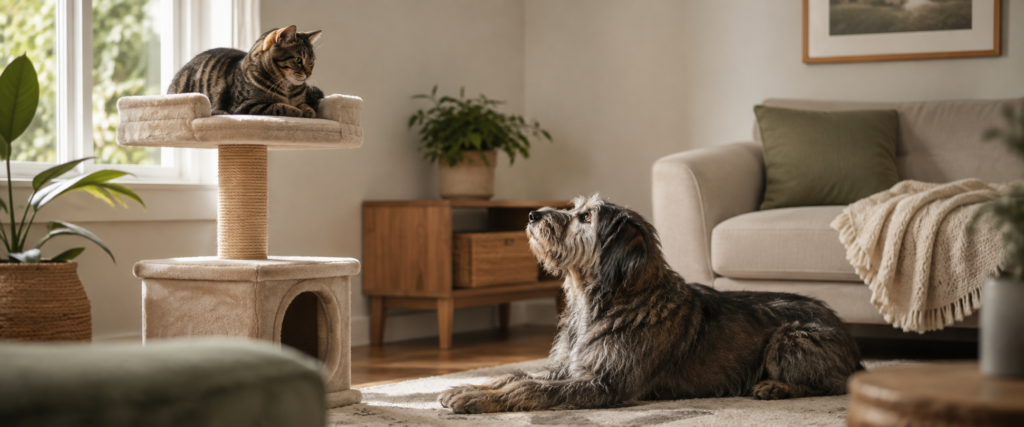
One of the most important things you can provide in a mixed cat-and-dog household is choice.
Cats need places where they can retreat without being followed. Vertical spaces such as cat trees, shelves, window perches, or furniture can give a cat the ability to observe the household while remaining safely out of a dog’s reach.
Food, water, resting areas, and litter boxes should also be accessible without requiring the cat to pass closely by the dog.
When cats know they can leave an uncomfortable situation, they are often less likely to feel that they need to defend themselves.
Teach the Dog That Calmness Pays
Even a friendly dog can be overwhelming to a cat.
Excited staring, following, barking, pawing, or chasing can make a cat feel unsafe—even when the dog has absolutely no intention of causing harm.
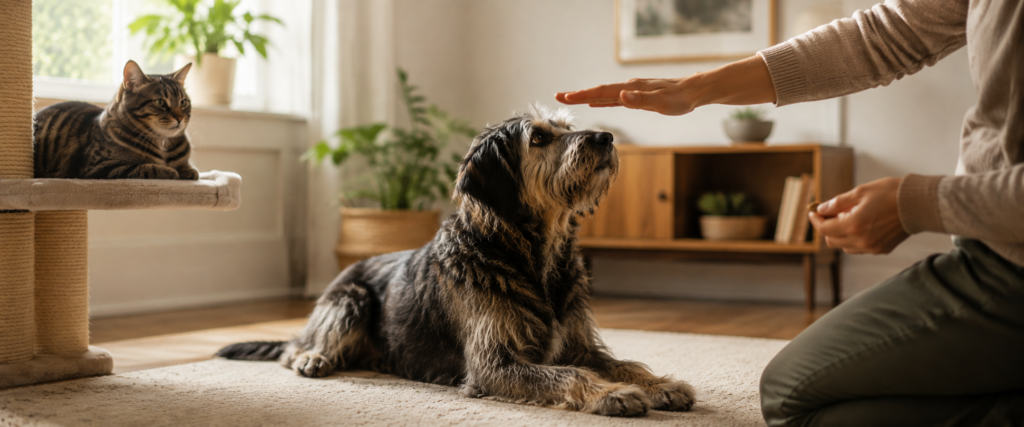
Reward your dog for calm behavior around the cat. Simple skills such as “leave it,” “stay,” “place,” and recall can be extremely valuable in a multi-pet household.
If the cat walks across the room and your dog remains relaxed, reward that behavior. Over time, your dog can learn that the cat’s movement is simply part of everyday life—not an invitation to chase.
Learn Their Different Languages
Sometimes what we call “bad behavior” is really communication we haven’t understood yet.
A cat hiding more frequently, avoiding certain rooms, swatting, eliminating outside the litter box, overgrooming, or changing eating habits may be experiencing stress.
A dog that becomes intensely focused on the cat, repeatedly follows them, blocks their movement, or cannot disengage may also be telling you that the situation requires more management.
Don’t focus only on obvious fighting. Peace is about more than the absence of aggression. It means both animals can eat, sleep, move around, play, and seek affection without constantly monitoring or avoiding each other.

Don’t Force Friendship
This may be the most important expectation to adjust.
Your cat and dog do not need to cuddle.
They don’t need to play together.
They don’t even need to particularly like each other.
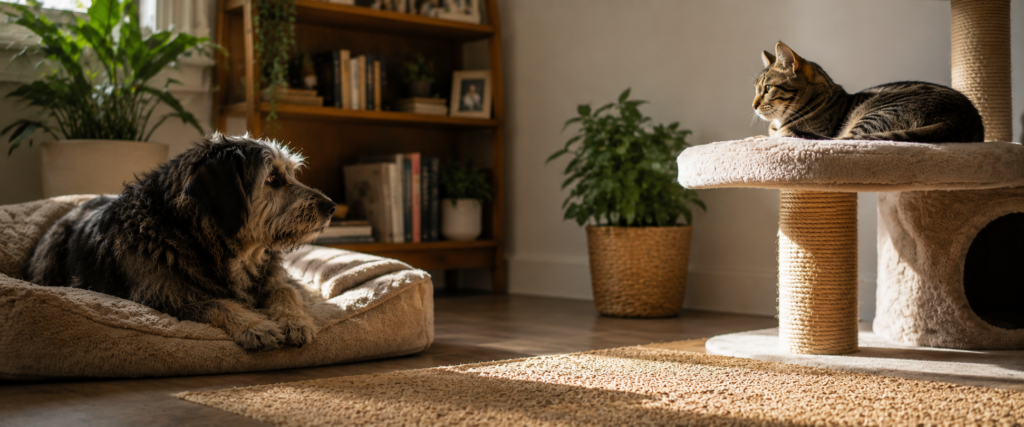
For some animals, success looks like sleeping side by side. For others, it means comfortably occupying opposite ends of the living room and respecting each other’s boundaries.
And that’s perfectly okay.
The goal should never be to create the relationship we want to photograph. The goal is to create the environment in which each animal can feel secure enough to choose the relationship that works for them.
When a Previously Peaceful Relationship Changes
If your cat and dog have lived together successfully and suddenly begin avoiding, chasing, growling, hissing, or fighting with each other, pay attention.
Behavioral changes can sometimes be connected to pain, illness, sensory changes, aging, cognitive decline, or increased anxiety. A senior pet, for example, may have much less tolerance for the energetic behavior they accepted when they were younger.
Rather than immediately labeling one pet as the problem, consider what may have changed.
A veterinary evaluation can help rule out underlying medical causes, while a qualified behavior professional can help when tension between pets becomes difficult to manage safely.
Harmony Is Built on Respect
A peaceful multi-pet household isn’t necessarily one where cats and dogs become best friends. It’s one where each animal has enough space, security, resources, and understanding to be themselves.
Give them safe places. Respect their boundaries. Reward calm interactions. Pay attention when their behavior changes. And above all, give the relationship time.
Because sometimes the most beautiful friendship between a cat and a dog isn’t the one where they’re curled up together.
It’s the one where both know they are safe at home.